
The Deceiver (Laccaria laccata)
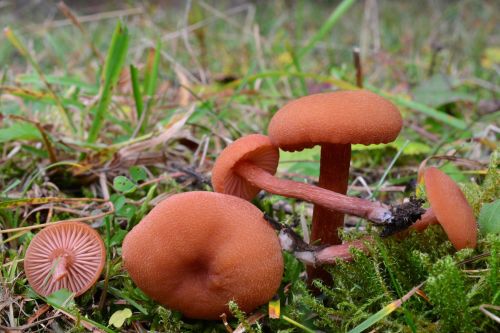


The Deceiver (Laccaria laccata) is a small, variable woodland mushroom commonly found throughout the UK. It grows in association with trees such as oak, birch and conifers, forming a mycorrhizal relationship with their roots. The Deceiver typically appears from summer through autumn and is often found scattered among leaf litter or moss. Despite its modest size and plain appearance, it is widely recognised by foragers due to its distinctive thick, widely spaced gills.
The name “Deceiver” comes from its highly variable colour and shape. When fresh and moist, the cap can appear reddish-brown or orange-brown, but as it dries it fades to pale buff or almost pinkish tones. This change can make identification confusing, especially for beginners. While generally considered edible, it has little flavour or culinary value and is more often collected for educational interest than for cooking.
Identification Features:
- Small mushroom, usually 2–6 cm cap diameter
- Cap colour reddish-brown to orange-brown when fresh
- Cap fades to pale buff or pinkish when dry
- Cap surface smooth, sometimes slightly uneven
- Cap often slightly depressed in the centre with age
- Gills are thick, widely spaced and waxy
- Gills colour similar to cap, sometimes paler
- Stem is slender and fibrous
- Stem colour similar to cap
- No ring or volva present
- Flesh thin and fragile
- Spore print is white
- Grows in woodland soil, not on wood
- Fruits summer through autumn
Foraging Safety:
- Generally considered edible but not highly valued
- Mild flavour, limited culinary appeal
- Key identification feature:
- Thick, widely spaced gills
- Colour changes significantly as it dries
- Can be confused with:
- Beginners should be cautious with:
- Small brown mushrooms in woodland
- Do not rely on cap colour alone
- Always check:
- Gill spacing
- Absence of ring or volva
- Avoid collecting from polluted areas
- Always cook before eating
- If unsure - leave it out
Identification video:
Mushroom Quiz 🍄
Question goes here