
Sickener (Russula emetica)
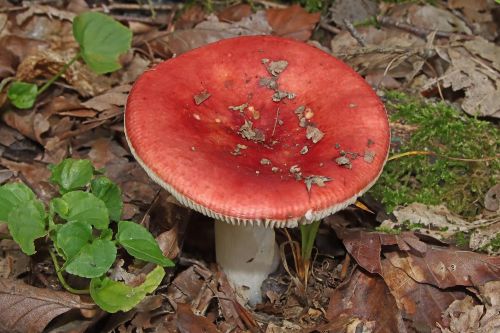
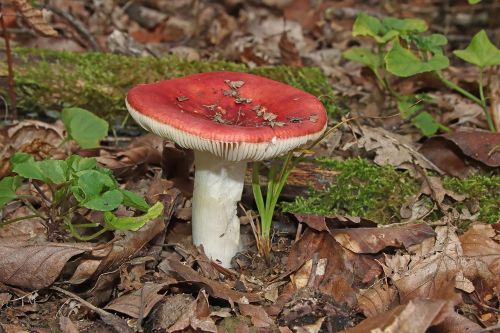
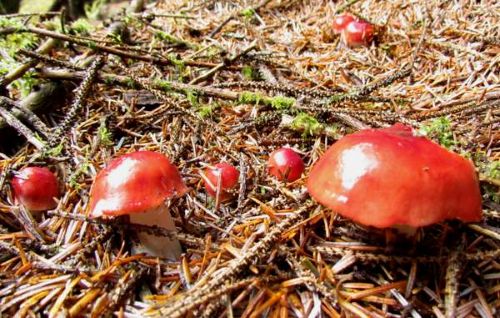
The Sickener (Russula emetica) is a bright red woodland mushroom commonly found across the UK, particularly in damp coniferous and mixed forests. It often grows near birch and pine trees, forming a mycorrhizal relationship with their roots. The cap is typically vivid scarlet to cherry red and smooth, becoming slightly flattened or depressed in the centre as it matures. The gills and stem are white, and like other members of the Russula genus, the flesh is brittle and snaps cleanly rather than bending. It usually appears from late summer through autumn and is most often found in mossy or wet woodland habitats.
Despite its attractive appearance, the Sickener is poisonous and should not be eaten. It contains compounds that irritate the digestive system, causing rapid onset of nausea, vomiting, abdominal cramps, and diarrhoea - which is how it earned its common name. While it is rarely life-threatening, ingestion can be extremely unpleasant. The bright red cap can cause confusion with other red Russula species, some of which are edible, making identification tricky for beginners. As a general safety rule, red-capped brittle gill mushrooms should be avoided unless identified with absolute certainty.
Identification Features:
- Bright scarlet to cherry-red cap
- Cap surface smooth and slightly shiny
- Cap starts convex, later flattening and sometimes slightly depressed
- Cap skin can often be peeled partway from the edge
- Gills are white, crowded and brittle
- Stem is white, firm and brittle
- No ring or volva present
- Flesh is white and very brittle (snaps like chalk)
- Spore print is white to pale cream
- Typically grows in damp woodland, especially with birch and conifers
- Often found in mossy areas
- Fruits summer through autumn in the UK
- Belongs to the Russula (brittlegill) family
Foraging Safety:
- Poisonous - do not eat
- Causes nausea, vomiting and stomach cramps
- Not usually fatal, but can cause severe gastrointestinal upset
- Frequently mistaken for:
- Other red Russula species
- Mild edible brittlegills
- Many red Russulas look very similar - identification can be difficult
- Colour alone is not reliable
- Russulas are brittle - but brittleness does NOT mean edible
- Cooking does NOT make it safe
- Beginners should avoid:
- All bright red Russula species
- Grows in common foraging habitats, increasing risk
- Children may be attracted to its bright colou
- If eaten accidentally:
- Seek medical advice if symptoms develop<
- Best advice:
- Avoid red brittlegills unless you have expert-level knowledge
Identification video:
Mushroom Quiz 🍄
Question goes here