
Wood Blewit (Lepista nuda)
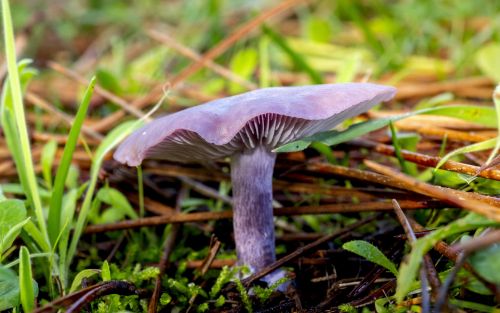


The Wood Blewit (Lepista nuda) is a popular wild edible mushroom found throughout the UK, particularly in deciduous woodland during autumn and early winter. Recognised for its distinctive lilac to violet colouring, this mushroom often stands out against fallen leaves and woodland debris. Young specimens display vibrant purple tones on the cap, gills and stem, although these colours gradually fade to pale brown or buff as they mature. Wood Blewits commonly grow in leaf litter beneath trees such as beech and oak, but they are also frequently found in garden compost heaps and woodchip mulch. Their ability to fruit after the first frosts makes them one of the more reliable late-season mushrooms for UK foragers.
As a wild edible species, the Wood Blewit is valued for its firm texture and rich, earthy flavour. It has a distinctive fruity or perfumed scent, often compared to orange juice, which is a helpful identification feature. However, careful identification is essential, as Wood Blewits can sometimes be confused with certain purple Cortinarius species, some of which are poisonous. When properly identified and thoroughly cooked, Wood Blewits are excellent in risottos, soups and creamy sauces. Because they are both visually striking and widely distributed across Britain, the Wood Blewit remains one of the most sought-after autumn mushrooms for responsible UK foragers.
Identification Features:
- Distinctive lilac to violet colouring on cap, gills and stem (especially when young)
- Cap becomes paler beige-brown with age, but usually keeps a lilac tint underneath
- Smooth cap with slightly inrolled edges when young
- Cap shape starts convex, later flattening out
- Gills are crowded and lilac, fading to buff/pinkish with age
- Thick, sturdy stem with no ring
- Flesh is pale with a faint purple hue
- Strong, pleasant fruity/perfumed smell (often described as frozen orange juice or perfume)
- Typically grows in leaf litter in woodland, compost heaps, or garden mulch
- Often appears in ,fairy rings or clusters
- Fruits from autumn through early winter in the UK (even after first frosts)
Foraging Safety:
- Must be cooked before eating - can cause stomach upset if eaten raw
- Colour fades with age, making ID harder - pick fresh purple specimens
- Possible confusion species:
- Some Cortinarius species (many are poisonous)
- Cortinarius mushrooms usually have a rusty brown spore deposit and cobweb-like veil (cortina)
- Always check for:
- Fruity smell
- No rusty brown gills/spores
- No cobweb veil remnants
- Avoid mushrooms from road verges, industrial areas, or treated mulch
- Only eat when fully confident in identification
Cooking Uses:
- Popular edible mushroom with a rich, earthy, slightly nutty flavour
- Texture becomes firm and meaty when cooked
- Excellent in:
- Creamy sauces
- Risottos
- Soups and stews
- Stir-fries
- Mushroom pies
- Pairs well with:
- Garlic, butter, thyme, cream, white wine
- Colour fades when cooked but flavour improves
- Must be thoroughly cooked for at least 15–20 minutes
video Recipe:
Mushroom Quiz 🍄
Question goes here