
Angel Wings (Pleurocybella porrigens)
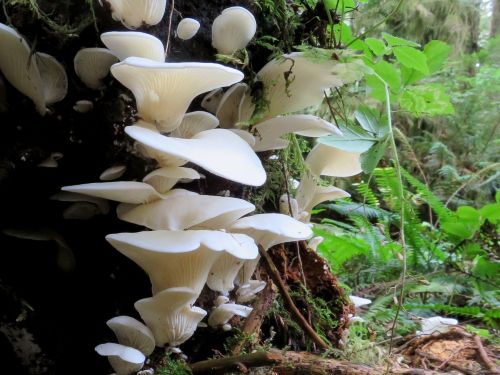


The Angel Wings (Pleurocybella porrigens) is a delicate white woodland mushroom that grows in clusters on decaying wood, particularly conifer logs. It is most commonly found in late summer and autumn in the UK. Because of its thin, fan-shaped caps and white decurrent gills, it can be mistaken for young Oyster Mushrooms, making it an important species for foragers to recognise. Its soft, fragile appearance and pure white colour give it its common name.
For many years, Angel Wings was considered edible in parts of the world. However, cases of serious poisoning were reported in Japan in the early 2000s, including incidents of acute encephalopathy (brain toxicity), particularly in individuals with pre-existing kidney conditions. Although severe cases appear rare, the mushroom is now widely regarded as unsafe to eat. Due to uncertainty surrounding its toxicity and its similarity to edible oyster species, it is best treated as poisonous and avoided entirely.
Identification Features:
- Pure white to ivory-coloured cap
- Cap is thin, fragile and fan- or shell-shaped
- Cap surface smooth and soft
- Gills are white and strongly decurrent (running down the stem)
- Stem is usually absent or very short
- Flesh is very thin and delicate
- No ring or volva present
- Spore print is white
- Grows in overlapping clusters
- Found on decaying conifer wood
- Typically appears on fallen logs and stumps
- Fruits late summer to autumn
Foraging Safety:
- Do not eat
- Associated with cases of serious neurological poisoning
- Higher risk for individuals with kidney issues
- Easily confused with:
- Key safety differences:
- Angel Wings are pure white and very thin
- Often grow on conifer wood
- Oyster Mushrooms are usually:
- Thicker
- Grey or cream
- Found mainly on hardwood
- Never rely on colour alone
- Avoid collecting white wood-growing mushrooms unless confident
- Cooking does NOT guarantee safety
- If ingestion is suspected:
- Seek medical advice immediately
- Best practice:
- Photograph and leave untouched
Identification video:
Mushroom Quiz 🍄
Question goes here