
Sulphur Tuft (Hypholoma fasciculare)
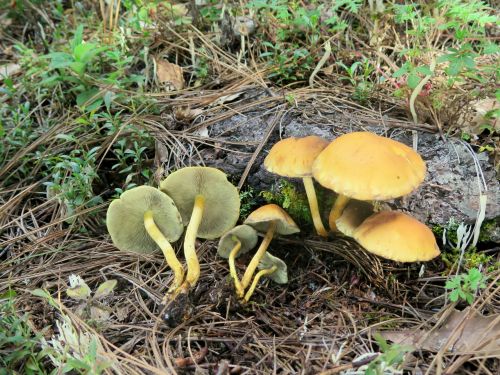


The sulphur tuft (Hypholoma fasciculare) is a very common poisonous mushroom found throughout the UK, particularly in woodland areas where it grows in dense clusters on decaying tree stumps, fallen logs, and buried wood, most often from spring through late autumn. It is easily recognised by its bright sulphur-yellow caps, which usually have a darker orange or brown centre, and its crowded gills that start yellow and turn greenish to olive as the mushroom matures. The stems are slender, yellow, and often darker toward the base, and the flesh has a notably bitter taste, although tasting should never be used as an identification method. Sulphur tuft is toxic and can cause unpleasant gastrointestinal symptoms such as nausea, vomiting, diarrhoea, and stomach cramps if eaten, though it is not usually fatal. It is sometimes confused with edible woodland mushrooms that also grow in clusters, making it particularly dangerous for inexperienced foragers. Due to its bright colouring, clustered growth on wood, and bitter nature, the sulphur tuft should always be avoided and treated as a key example of a common but harmful UK mushroom that should never be consumed.
Identification Features:
- Cap colour sulphur yellow to yellow-green, often with a darker orange-brown centre
- Cap starts rounded, later flattening with age
- Cap surface is smooth and slightly sticky when damp
- Gills are yellow at first, becoming greenish-grey to olive as spores mature
- Gills are crowded and attached to the stem
- Stem is thin, yellow, often darker toward the base
- No true ring on the stem (may show faint ring zone)
- Flesh is pale yellow
- Smell is unpleasant - often musty, sour or mouldy
- Taste is extremely bitter (do NOT taste when foraging)
- Grows in dense clusters
- Found on rotting stumps, logs and buried wood
- Common on both hardwood and conifer wood
- Fruits spring through late autumn, sometimes into winter
Foraging Safety:
- Poisonous - do not eat
- Causes severe gastrointestinal upset
- Nausea
- Vomiting
- Diarrhoea
- Abdominal pain
- Very commonly mistaken for edible wood-growing mushrooms
- High risk of confusion with:
- Key danger differences:
- Sulphur Tuft has greenish gills
- Sheathed Woodtuft has brown gills and a clear ring
- Never rely on:
- Colour alone
- Cluster growth alone
- Avoid collecting any yellow mushrooms growing in clusters on wood unless fully confident
- Bitter taste is a warning sign - but never taste-test
- Common in public areas:
- Parks
- Woodland paths
- Gardens
- Dangerous to children and pets
- If ingestion is suspected:
- Seek medical advice immediately
- Monitor symptoms closely
- Best practice:
- Learn to recognise and avoid
- Leave undisturbed
Identification video:
Mushroom Quiz 🍄
Question goes here