
Death Cap (Amanita phalloides)
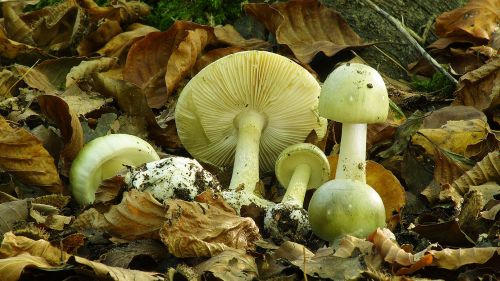

The Deathcap mushroom (Amanita phalloides) is widely regarded as the most dangerous mushroom found in the UK and across Europe. Despite its often attractive and unassuming appearance, it contains extremely potent toxins called amatoxin which are responsible for the majority of fatal mushroom poisonings worldwide. These toxins primarily attack the liver and kidneys, preventing cells from producing essential proteins and leading to organ failure. What makes the Deathcap especially dangerous is that early symptoms are often delayed, typically appearing 6–24 hours after ingestion, which can cause people to underestimate the seriousness of the poisoning. Even modern medical treatment struggles to reverse the damage once symptoms fully develop, and ingestion of a single mature mushroom can be fatal.
Deathcaps form symbiotic relationships with broadleaf trees such as oak and beech, which is why they are commonly found in woodlands, parks, gardens and grassy areas rather than remote wilderness. This brings them into close proximity with the public, including children, pets and inexperienced foragers. They are often mistaken for edible species due to their pale colour, neat shape and pleasant smell when young. Crucially, no method of preparation makes a Deathcap safe, cooking, drying, freezing or soaking does not neutralise the toxins. Because of their extreme toxicity, accurate identification and absolute avoidance are essential, and any suspected ingestion must be treated as a medical emergency.
Identification Features:
- Cap colour ranges from olive-green, yellow-green to brownish
- Cap surface is smooth and slightly sticky when wet
- Cap shape starts rounded, later flattening with age
- Gills are pure white, crowded and free from the stem
- Stem is white to pale green, often with fine vertical markings
- Prominent white ring (skirt) on the upper stem
- Distinct volva (white cup) at the base of the stem
- Often hidden underground - must dig carefully to see it
- Flesh is white and does not change colour when cut
- Smell is mild when young, becoming sweetly unpleasant in older specimens
- Spore print is white
- Typically grows near oak, beech and other broadleaf trees
- Found in woodlands, parks, gardens and grassed areas
- Fruits late summer to autumn in the UK
Foraging Safety:
- Never eat under any circumstances, one of the deadliest mushrooms in the world
- Responsible for the majority of fatal mushroom poisonings in the UK and Europe
- Even small amounts can be fatal
- Poisoning symptoms may be delayed 6–24 hours, giving a false sense of recovery
- Causes severe liver and kidney failure
- Cooking, drying, freezing or peeling does NOT make it safe
- Can be mistaken for edible mushrooms, including:
- Puffballs (when young and unopened)
- Field mushrooms
- Paddy straw mushrooms (in other countries)
- Always cut mushrooms in half when foraging:
- Deathcaps have gills inside, puffballs are solid white inside
- Key danger signs to check:
- White gills
- White stem
- Volva (cup) at the base, often hidden underground
- Commonly found near oak, beech and other broadleaf trees
- Grows in parks, woodland, gardens and grassed areas
- Children and pets are at high risk, remove safely if found in gardens
- If ingestion is suspected:
- Seek emergency medical help immediately
- Do not wait for symptoms to worsen
- Never rely on:
- Smell
- Taste
- Insect damage
- Old “folk rules” for safety
Identification video:
Mushroom Quiz 🍄
Question goes here