
Panther Cap (Amanita pantherina)
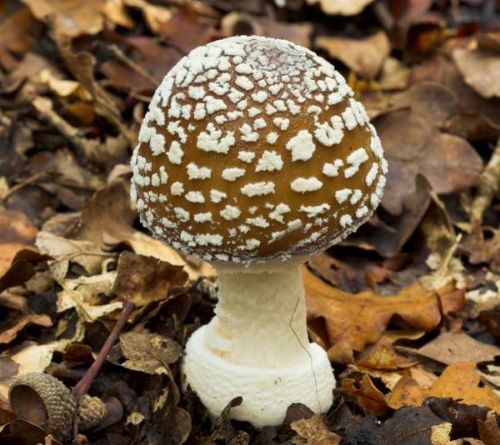

The panther cap (Amanita pantherina) is a dangerous poisonous mushroom found throughout the UK, most commonly in mixed and deciduous woodland from late summer to autumn. It typically grows in association with trees such as oak, beech, and pine, forming mycorrhizal relationships with their roots. The cap is usually brown to olive-brown and is decorated with small white wart-like patches that can fade or wash away with rain, sometimes making the mushroom harder to recognise. Underneath the cap are white, crowded gills that do not attach to the stem, while the stem itself is white, slender, and features a distinct ring along with a swollen base surrounded by clear volval remnants. The panther cap contains potent toxins including muscimol and ibotenic acid, similar to those found in the fly agaric but often in higher concentrations, which can lead to serious symptoms such as vomiting, abdominal pain, confusion, hallucinations, loss of coordination, and extreme drowsiness if ingested. Because it can be mistaken for edible brown mushrooms by inexperienced foragers, the panther cap presents a significant risk and should never be eaten it should only ever be observed in the wild as an example of a highly toxic and potentially life-threatening species.
Identification Features:
- Cap colour ranges from brown, olive-brown to dark chestnut
- Cap covered with small white warty spots
- These are veil remnants and can wash off in rain
- Cap starts rounded, later flattening with age
- Cap margin often shows fine striations (lines) near the edge
- Gills are white, crowded and free from the stem
- Stem is white, slender and smooth
- Prominent white ring (skirt) on the upper stem
- Base of stem has a distinct bulb with sharp, collar-like ridges
- A key feature separating it from Fly Agaric
- Flesh is white and does not change colour when cut
- Spore print is white
- Grows near broadleaf and conifer trees
- Found in woodland, parks and heathland
- Fruits summer to autumn in the UK
Foraging Safety:
- Highly poisonous - do not eat
- Contains ibotenic acid and muscimol, similar to Fly Agaric but more potent
- Causes serious symptoms including:
- Nausea and vomiting
- Severe confusion and delirium
- Hallucinations
- Loss of coordination
- Agitation or extreme drowsiness
- Effects are unpredictable and can be intense even in small amounts
- Often mistaken for:
- Fly Agaric (when red colour is absent or faded)
- Other brown-capped Amanita species
- Other brown-capped Amanita species
- Cooking, drying or processing does NOT make it safe
- Dangerous to children and pets
- Never rely on:
- Colour alone
- Old foraging myths or internet anecdotes
- If ingestion is suspected:
- Seek urgent medical attention
- Do not wait for symptoms to appear
- Best advice:
- Do not collect
- Photograph and leave undisturbed
Identification video
Mushroom Quiz 🍄
Question goes here